The 4th Universal Cup Semifinals: Results and Highlights
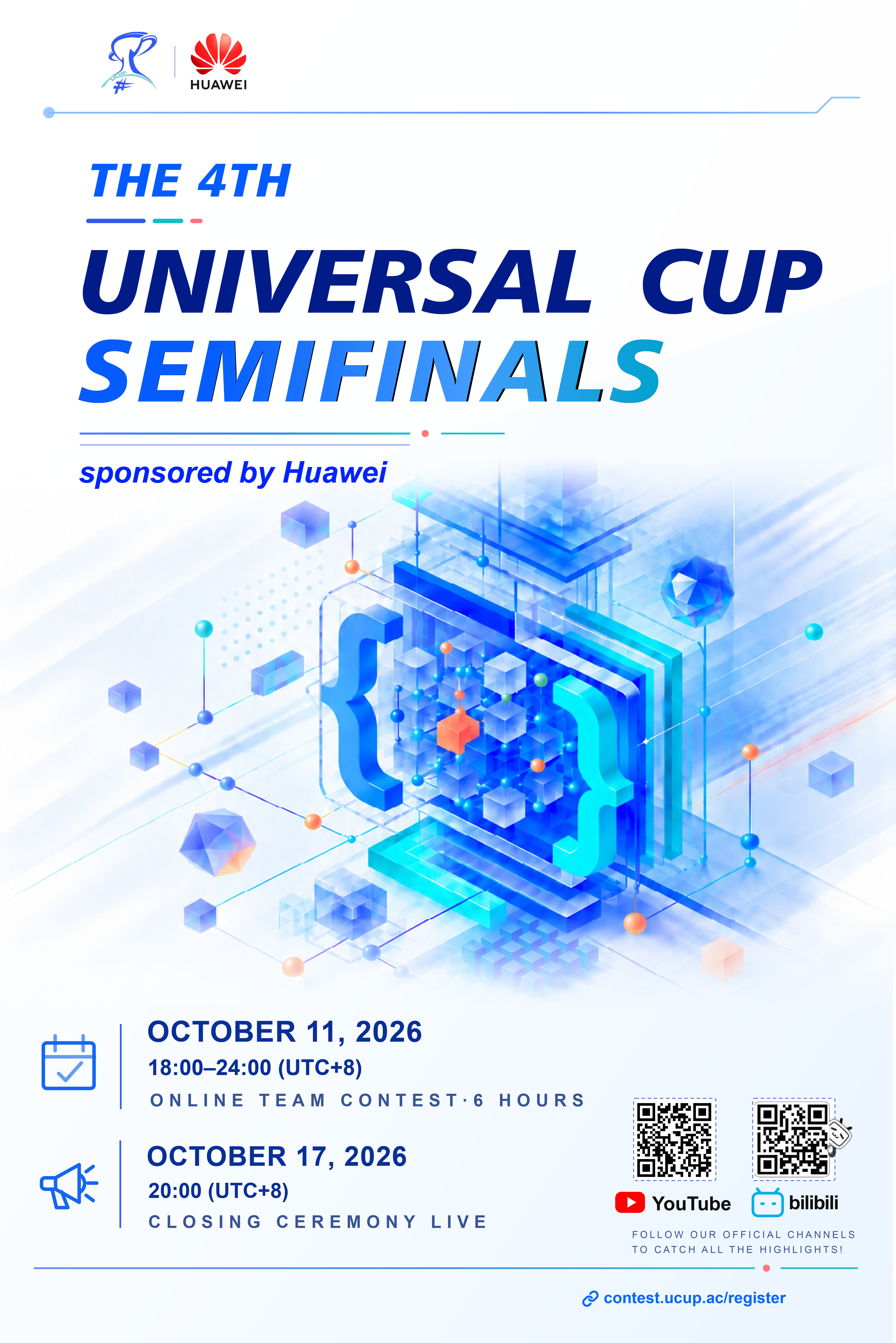
The 4th Universal Cup Semifinals have concluded. Teams competed online for six hours on October 11, 2026, from 10:00 to 16:00 UTC (18:00 to midnight Beijing time, UTC+8). The final standings were announced at the closing ceremony on October 17.
Contest Overview
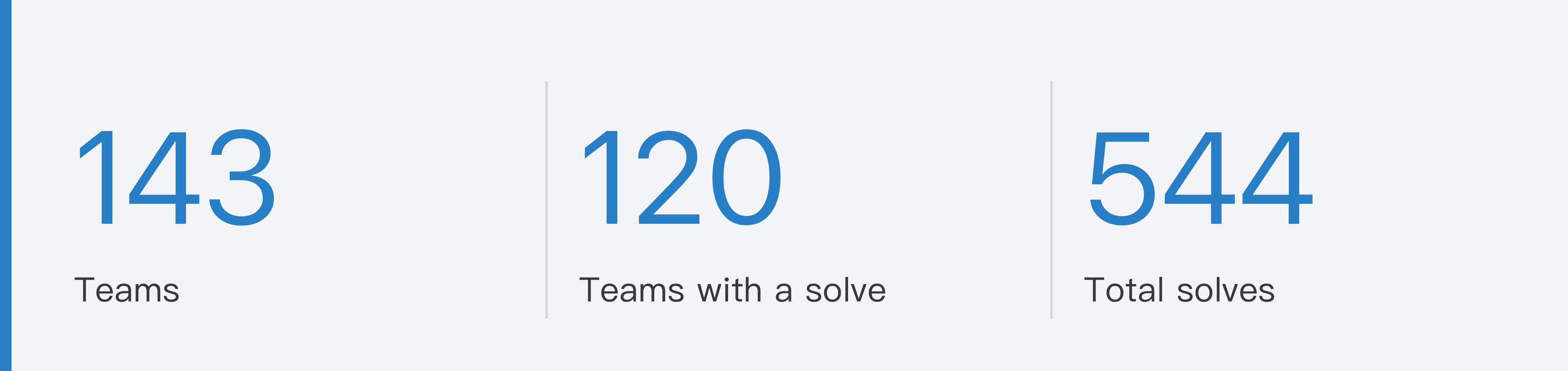
A total of 143 teams registered for the contest, with participants from secondary schools, universities, and companies. 120 teams solved at least one problem, recording 544 solves between them.
The contest featured 13 problems. Ten were solved by at least one team, while Problems A, B, and C remained unsolved. One team finished with nine problems solved, four teams solved eight, and another ten teams solved seven.
Final Standings
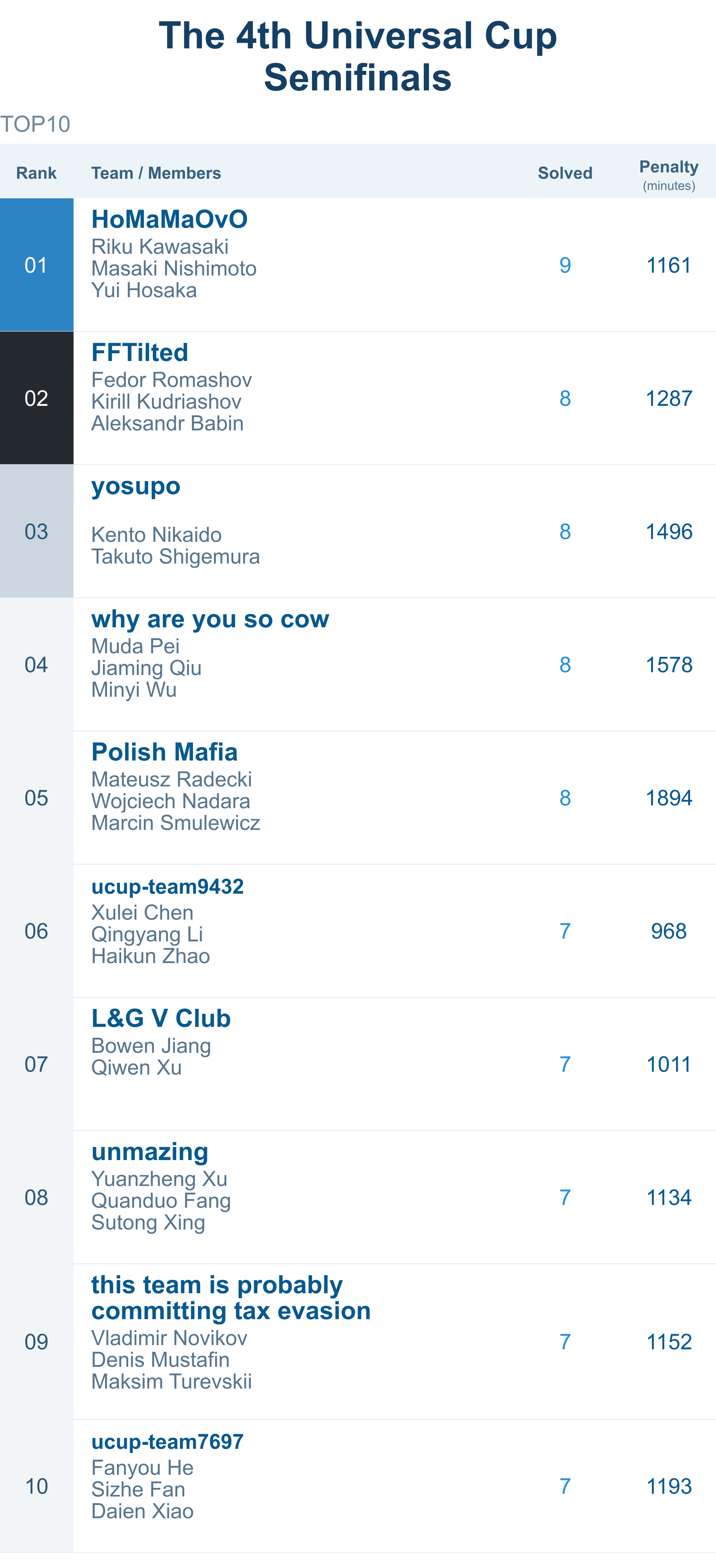
The teams in sixth and tenth place are shown by their official contest accounts, as confirmed English team names were not available.
HoMaMaOvO, comprising Riku Kawasaki, Masaki Nishimoto, and Yui Hosaka, won the Semifinals. Between them, the team members' past achievements include IOI gold medals, IMO gold medals, and third place at the ICPC World Finals. Their ninth and final solve came on Problem G, approximately four hours and 46 minutes into the contest. Only two official teams solved that problem. HoMaMaOvO finished one problem ahead of the runners-up, with a total penalty of 1,161 minutes.
FFTilted, from Higher School of Economics in Russia, took second place. Its members, Fedor Romashov, Kirill Kudriashov, and Aleksandr Babin, are the same trio who won the 2023 ICPC World Finals. They solved eight problems with a total penalty of 1,287 minutes, the lowest among the four teams that solved eight problems.
yosupo placed third with eight problems solved and a total penalty of 1,496 minutes. Team member Kento Nikaido has achieved top-ten finishes at both Google Code Jam and Facebook Hacker Cup. Takuto Shigemura and HoMaMaOvO's Riku Kawasaki were teammates on the University of Tokyo team that placed third at the 2019 ICPC World Finals. Both finished in the top three again, this time on different teams.
Just over seven minutes into the contest, L&G V Club recorded the contest's first accepted submission on Problem E. Problem E went on to become the contest's most widely solved problem.
unmazing was the only official team to solve Problem F, completing it approximately one hour and 40 minutes after the start.
A Message from the Chair
Jingbang Chen
Co-Founder and Co-President, Universal Cup
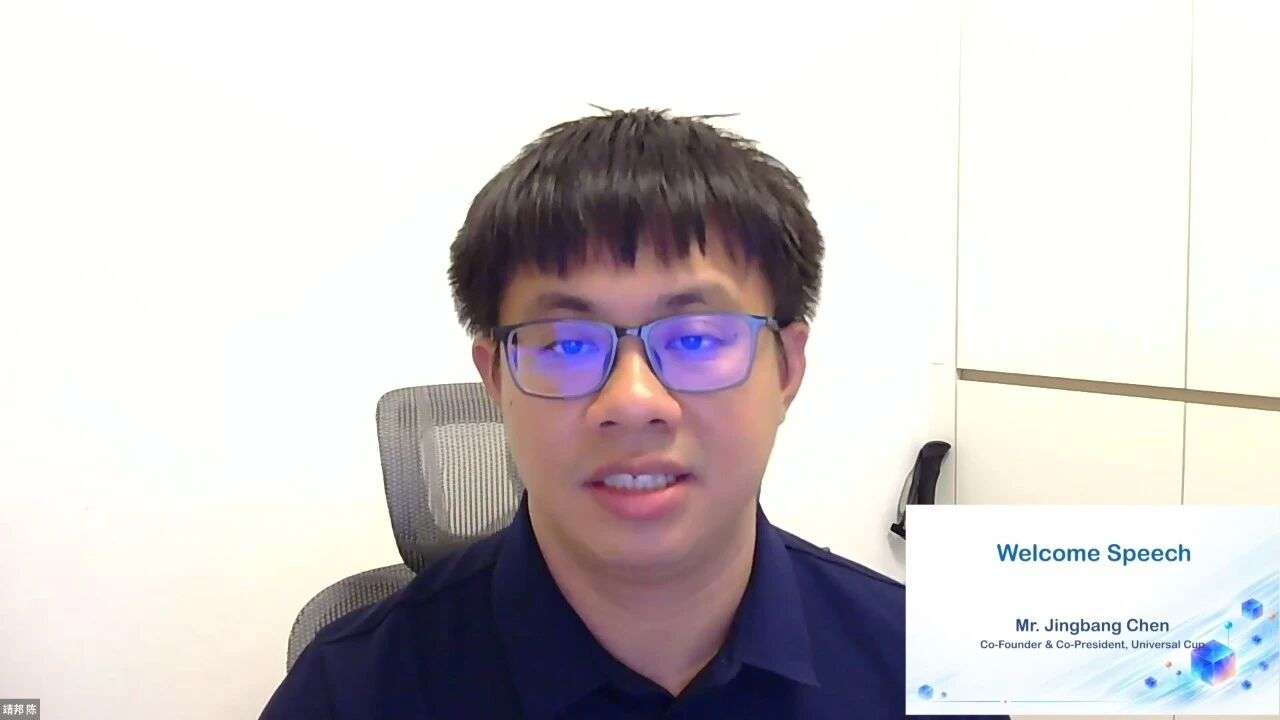
For us, Universal Cup is about both the competition and the community around it. We want to give people good problems to work on, strong teams to compete against, and opportunities to learn from one another. There is still much for us to improve, and we welcome your feedback and suggestions. Making Universal Cup better is something we hope to do together with all of you.
Tech Talk by Huawei
At the closing ceremony, Dr. Yufei Ge, an invited speaker from Huawei, delivered a talk titled Low-Density Parity-Check Decoding Algorithm Based on Quantum Annealing Inspired Algorithm, focusing on decoding in communication systems.
The talk introduced the basics of low-density parity-check (LDPC) codes before explaining how to formulate LDPC decoding as an optimization problem and solve it using a quantum annealing inspired algorithm (QAIA). It also explored using deep unfolding (DU) to learn key parameters of the iterative algorithm through training, with the aim of improving LDPC decoding performance.
Dr. Ge also invited interested contestants to explore this decoding problem further in the next UCup Winter Challenge.

Beyond the Scoreboard
At the closing ceremony, Universal Cup Co-Founder and Co-President Qingyu Shi reviewed the contest with the audience. This edition introduced a six-hour format for the Semifinals, giving teams more time to tackle the problems and the setters greater flexibility in balancing the problem set. Revealing the submissions made during the scoreboard freeze allowed viewers to see how teams' late-contest progress affected the final standings.
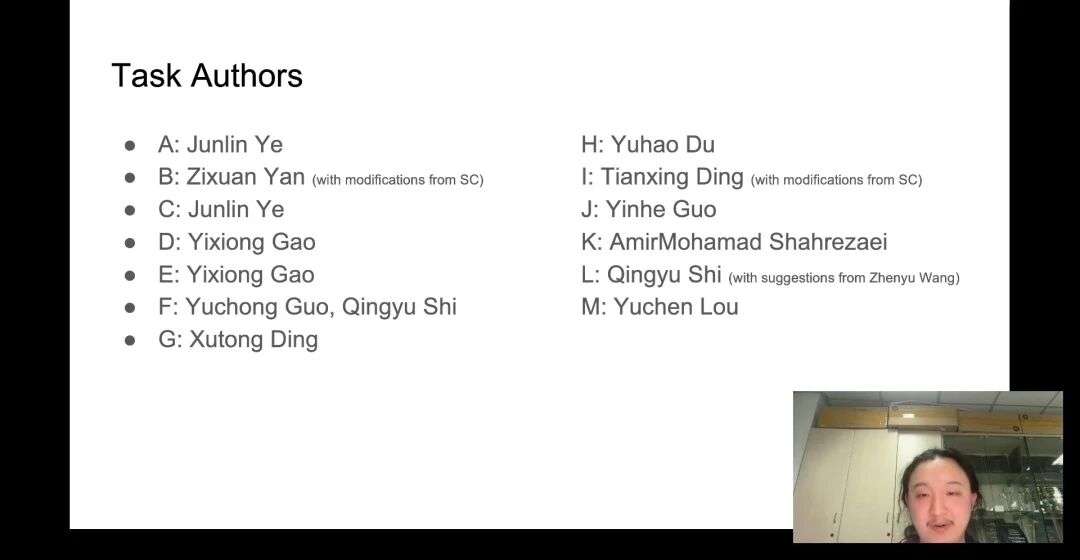
Qingyu also shared how the problem set was prepared. The team received more than 160 problem proposals from over ten countries and shortlisted 18, of which 13 were selected for the contest. Three versions of the problem set were prepared for testing. Problem authors, reviewers, judges, and testers worked through repeated rounds of discussion, testing, and revision before the set was ready.
What's Next
We thank everyone who contributed their time and effort to the Semifinals, and everyone who followed and supported the event. Your trust in Universal Cup motivates us to keep improving the competition.
We invite the community to submit problem proposals for the 4th Universal Cup Finals. Universal Cup also plans to organize challenge contests with industry partners and hold in-person events at several locations, giving participants more opportunities to meet and exchange ideas.
Please stay tuned to our official channels for details about the Finals, challenge contests, and in-person events.
A look back at the 2026 Universal Cup Finals, an earlier in-person event.
Closing Notes
We are grateful to Huawei Technologies Co., Ltd. for its generous support, which helps us bring contestants together from around the world and provide opportunities to compete, learn, and exchange ideas.
See you at the next Universal Cup event.